AI16 October 202610 min
The AEO Checklist for Technical Content
A 5-step AEO checklist for technical content. Structure tutorials and docs so ChatGPT, Perplexity, and Google AI Overviews cite them.
 Theodore Kelechukwu Onyejiaku
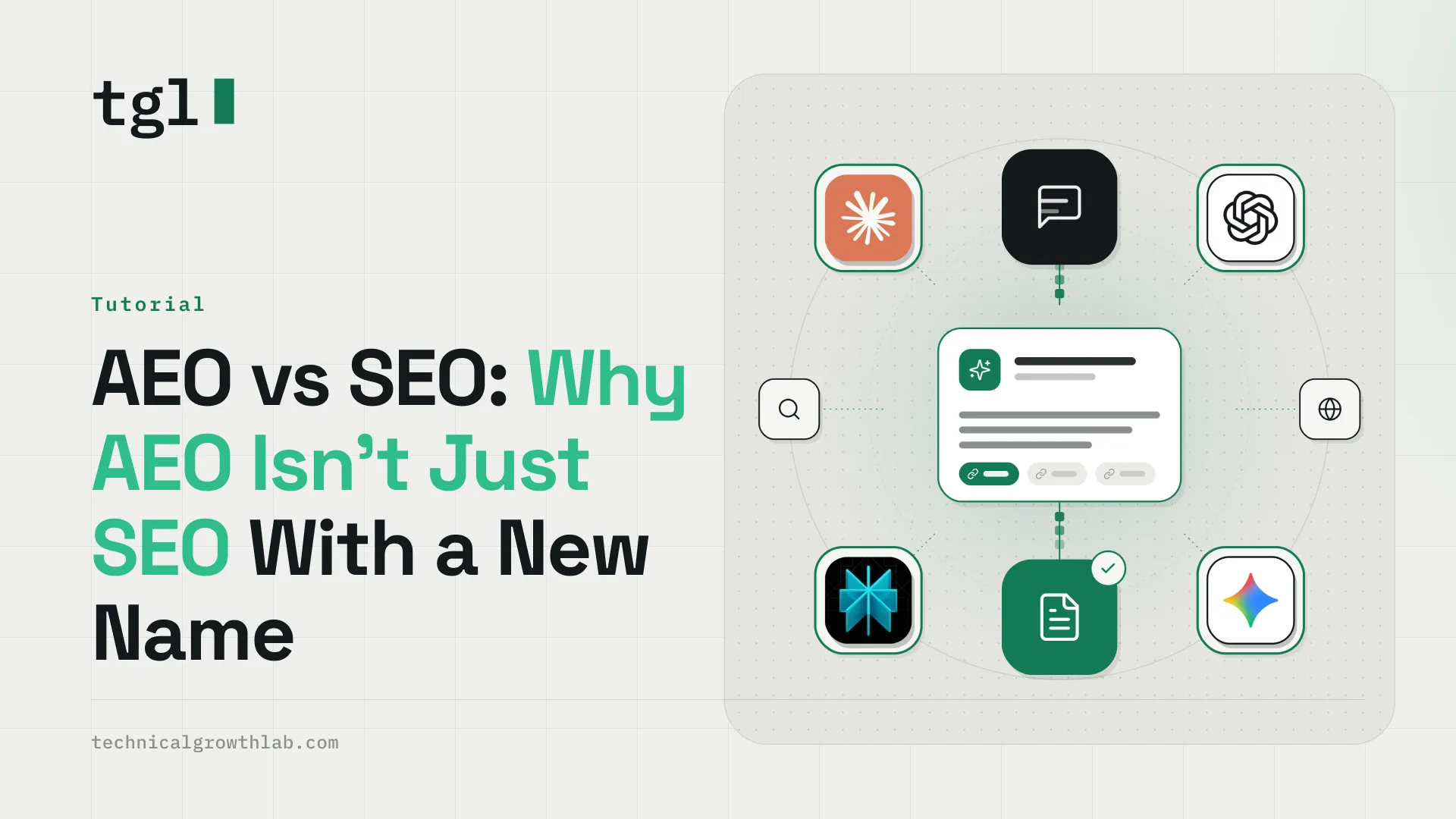
AEO vs SEO: they overlap, but they target different outcomes. Learn the 5 differences and three steps to take this week.
 Chiziterem Ihekuna5 min read
Last updated: October 25, 2026
Isn’t answer engine optimization (AEO) just SEO with a new name?
It’s a fair question, and the answer is: partly. Google says that no special optimization is required for AI Overviews and AI Mode, and that existing SEO fundamentals still apply. Quality content, crawlability, and authority still matter, and a strong SEO foundation helps you in AI search too.
But ranking and being cited are not the same outcome. Search engines return a list of links for people to choose from. Answer engines like ChatGPT, Perplexity, Microsoft Copilot, and Google’s AI Overviews synthesize a response and cite a handful of sources. That difference changes how you plan, write, and measure your work. Here are five ways AEO and SEO differ.
robots.txt, and set an AI visibility baseline.SEO aims to rank your pages and earn clicks. AEO aims to get your brand selected, cited, or mentioned inside AI-generated answers.
Take an accounting software company. Its SEO question is: “Can we rank for ‘best accounting software for small businesses’?” Its AEO question is: “When someone asks ChatGPT to recommend accounting software for a small business, are we part of the answer?”
The two outcomes don’t guarantee each other. A page can rank well and never be cited in an AI answer. A brand can also be mentioned in an answer without the user ever visiting its site.
SEO tracks rankings, organic traffic, click-through rate, and conversions. These still matter, but they can’t show how your brand appears inside AI answers. AEO adds:
Measurement is still uneven. Bing Webmaster Tools launched an AI Performance report in February 2026 (public preview) that shows citations in Copilot and Bing’s AI summaries, but it doesn’t cover ChatGPT. Google reports AI Overviews and AI Mode traffic within Search Console’s standard performance data, so you can’t easily separate it out. For other platforms, you’ll mostly rely on manual testing and third-party tools.
Both disciplines need helpful, original content. AEO adds a focus on passages that an AI system can pull out and represent accurately.
Imagine a long guide to email marketing. It may rank well because it covers the topic thoroughly. But if someone asks an AI assistant “What is email segmentation?”, the assistant needs a clear, reliable explanation of that one concept. A page that buries its definition under several paragraphs of general commentary is harder to use.
This doesn’t mean replacing depth with short answers. It means making key information easy to find:
Structured data can help search engines understand a page, but Google states there is no special schema markup you need for AI features. Don’t expect schema alone to earn you citations.
For a step-by-step version of this for tutorials and docs, see The AEO Checklist for Technical Content.
Answer engines pull from many sources, not just your website. If your homepage calls you an “enterprise security platform,” your LinkedIn page says “threat intelligence tool,” and a directory lists you as “IT consulting,” it’s harder for any system to understand what you do.
To fix this:
Third-party credibility matters because calling yourself an industry leader on your own site doesn’t prove it. Independent reviews and reputable coverage add context. Be realistic, though: no one has published a formula for how many mentions or backlinks trigger a citation, and each platform retrieves and selects sources differently. Treat this as credibility-building, not a hack.
In traditional search, someone compares results and clicks through to a few sites. With an AI assistant, they can ask “Which project management tool is best for a remote team of 15 on a limited budget?” and get a tailored comparison with a few cited sources. Your brand can influence that decision without receiving a visit.
Website traffic still matters, and AI features can send visitors to the sources they cite. But traffic alone no longer captures every way people discover your brand. You need to earn visibility where people click links and credibility where they read answers. SEO supports the first goal. AEO addresses the second.
You don’t need to rebuild your site or abandon your SEO strategy. Start here:
robots.txt. OpenAI says sites opted out of OAI-SearchBot won’t appear in ChatGPT search answers, so make sure you haven’t blocked it by accident with a broad rule meant for scrapers. Allowing crawlers doesn’t guarantee a citation, but blocking them rules you out.Technical Growth Lab (TGL) helps businesses combine SEO and AEO into one strategy, from content and technical setup to AI visibility tracking.
👉 Book a free AI visibility review with TGL
SEO is the foundation. AEO builds on it by asking a different question: not just “Can people find us?” but “Will AI answers include us?” The disciplines share principles, and much of the work that improves one supports the other. But shared foundations don’t make them identical, and treating them as the same leaves a gap in how you measure and plan.
Brands that understand the difference can build one strategy that earns rankings, citations, and customers.
Partly. AEO relies on the same foundations as SEO, including quality content, crawlability, and authority. But SEO aims to rank pages and earn clicks, while AEO aims to get your brand cited or mentioned inside AI-generated answers. The goals, metrics, and content structure differ.
No. Google says no special optimization or schema markup is required for AI Overviews and AI Mode, and that existing SEO fundamentals still apply.
Track citations, brand mentions, share of answer against competitors, and citation quality. Bing Webmaster Tools reports citations in Copilot and Bing's AI summaries. For ChatGPT, Perplexity, and Google AI Mode, test a fixed set of buyer questions each month and record the results.
Yes, if you want to appear in ChatGPT search answers. OpenAI says sites that opt out of OAI-SearchBot won't appear in them. Allowing the crawler doesn't guarantee a citation, but blocking it rules you out.
Next step
A 30-minute call: we look at what you have published, where you are and are not being cited today, and what a first engagement would cover. You leave with a scope and a price, whether or not you work with us.